Friday, December 31, 2021

Year's End


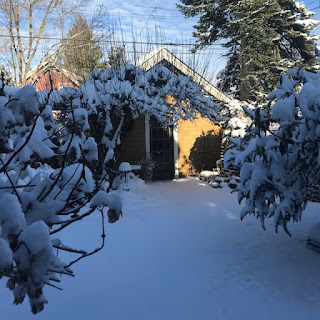
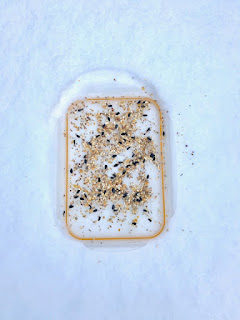
My door to the outside is mostly glass and allows a view from my reading chair (not quite the view above). The view this week was mostly snow, though there were more chickadees than usual. After the last snowfall (over 20 cms on Wednesday night) I hauled out the sack of bird seed I purchased last summer and set up a feeding station (in the middle of the yard, pictured above). 

It took about twenty minutes for the chickadees to muster the trust to land at my station. Or maybe they were negotiating with each other as to who goes first, second, third ... -- the proverbial pecking order. Eventually the first chickadee landed, and it stood there for the longest time -- not feeding. After a few jerky pecks it flew off and was followed but a second, a third ... 

-- until out of nowhere came this flicker, all wings and colour and relatively huge. I opened the door and off it went. I watched for an hour, and it never came back. I counted 26 chickadees in that hour. Or maybe it was the same three chickadees, taking turns.

Thursday, December 30, 2021

Daybook: the Journal of an Artist (1982)


After stopping into Pulp Fiction yesterday ("Do you have the Highsmith dairies in paper yet?" CB: "It's barely out in cloth, and publishing being what it is, there's no guarantee of a paperback"), I popped into the Sally Anne on 12th where I found a DVD of that 2005 Enron documentary (Hmm, Mark Cuban was a Co-Exec on this), a DVD of John Sayles's 2002 Sunshine State (private developers attempt to buy up a Florida resort island from its longtime residents) and three books: J. D. Vance's Hillbilly Elegy (2016), Marina Lewycka's A Short History of Tractors in Ukrainian (2005) and Anne Truitt's Daybook: the Journal of an Artist (1982).

I had heard of the first two books, but the third was new to me. Blurbed as "[a] remarkable record of a woman's reconciliation of art, motherhood, memories of childhood and present day demands," it is, more metrically, a year-long diary of daily entries started after Truitt's two retrospective exhibitions (one at the Whitney, in December 1973; the other at the Corcoran, in April 1974), and begins with this realization:

"The works stood clear, each in its own space, intact. I myself who, the longer and the more intensely we worked, failed to stand clear. I felt crazed, as china is crazed, with many fissures. It slowly dawned on me that the more visible my work became, the less visible I grew to myself. In a deeply unsettling realization, I began to see that I had used the process of art not only to contain my intensities but also to exorcise those beyond my endurance, and must have done so with haste akin to panic, for it was a kind of panic I felt when once again inexorably confronted by my own work. Confronted, actually, by the reactivations of feelings I had thought to get rid of forever, now so objectified that I felt myself brutalized by them, defenceless because I had depended on objectification for defence." (4)

I wonder what an art therapist would make of Truitt's confession. After all, isn't art therapy interested in the art-making process as way to sort out the maker's personal problems? Surely it's more than that. I will send the passage to a friend whose co-vivant is an art therapist, see what safeguards art therapists have on hand to keep the art and the artist what? -- unified?

Poking out of the book is a mint condition bookmark from the Vancouver Women's Bookstore Co-operative, when it was at 315 Cambie Street (1983-?).

Wednesday, December 29, 2021

The Selected Screenplays of Joan Didion


The picture above is from A Star Is Born (1976), Esther Hoffman's coming out performance at the American Indian Relief Fund concert. John Norman Howard Speedway was scheduled to perform in that spot, but Howard stopped the band after the first two bars to introduce Hoffman, who was not expecting to perform, though Hoffman's backup singers, the unfortunately named Oreos, were in on the surprise.

I have never seen the preceding A Star Is Born (1954), nor the 1937 version, for that matter, so I am not sure how much this scene borrows from its earlier writers (Moss Hart, Dorothy Parker, et al.) and how much was written by 1976 re-make writers Joan Didion, John Gregory Dunne and director Frank Pierson. What we do know is that the "star" of the 1954 and 1937 versions was named Esther Blodgett (before adopting the stage name Vicki Lester), and that her mentor was singer-actor Norman Maine. Esther/Vicki's debut was not at the American Indian Relief Fund concert, but a musical in which both she and Maine appeared.

The 1976 version of A Star Is Born is not the first screenplay Didion co-wrote, nor the last. She and Dunne teamed up to write another old guy mentor/ambitious young woman (journalist) tale called Up Close & Personal (1996). Before that, an old guy (tor-)mentor/operatively ambivalent young woman (actor) tale based on Didion's novel, Play It As It Lays (1972), which you can watch here, in full.

Tuesday, December 28, 2021

The Alexandria Quartet (1958-1960; 1962)


Lawrence Durrell (1912-1990) is a writer who was always there. Not there to return to, or there to rescue me, but there in that great cacophony of early-to-mid-20th century English fiction. Yes, I would get to him one day -- after Stein, Lawrence, Joyce, Woolf, Faulkner, Fitzgerald, Beckett, Baldwin ....

For some reason I can recall the many occasions when Durrell's name came up, always with a stated appreciation of his genius and prose style, often in the name of "travel writing". Mostly it was women who mentioned him, writers like local "Giantesses" Judith Copithorne and Maxine Gadd. Marian Engel mentions him in Monodromos (1973; republished as One-Way Street), which had me wondering whether he was an influence. As Maxine once said, everyone was reading Durrell "back in the day," and Engel was in Cyprus in the early-1960s.

In late-November I found Durrell's 900 page The Alexandria Quartet in the curated book section of the BC SPCA Thrift Store. Like Kurosawa's Rashomon (1950), Durrell's tetralogy tells a story from multiple points of view, with each carefully wrought -- if not exhausting -- sentence seemingly born from an afternoon's worth of musing. Presently I am on Page 54 of the first book, Justine (1958), on the heels of an impoverished Nick Caraway-like narrator as he is caught in the slipstream of 1930s bourgeois Alexandria, Egypt, carried along by his better-off friends (including Justine), while anchored to his Greek girlfriend, Melissa, with whom he lives, and cares for.

There is a paragraph on pages 46-47 that bears re-reading. According to Durrell's narrator,

"[t]here is a passage in one of Justine's diaries which comes to mind here. I translate it here because though it must have referred to incidents long preceding those which I have recounted yet nevertheless it almost exactly expresses the curiously ingrown quality of love which I have come to recognize as peculiar to the city rather than to ourselves. 'Idle' she writes 'to imagine falling in love as a correspondence of minds, thoughts; it is a simultaneuos firing of two spirits engaged in an autonomous act of growing up. And the sensation is of something having noiselessly exploded inside each of them. Around this event, dazed and preoccupied, the lover moves examining his or her own experience; her gratitude alone, stretching away towards a mistaken donor, creates the illusion that she communicates with her fellow, but this is false. The loved object is simply one that has shared an experience at the same moment of time, narcissistically; and the desire to be near the beloved object is at first not due to the idea of possessing it, but simply to let the two experiences compare themselves, like reflections in different mirrors. All this may precede the first look, kiss, or touch; precede ambition, pride or envy; precede the first declarations which mark the turning point -- for from here love degenerates into habit, possession, and back to loneliness.' How characteristic and how humourless a delineation of the magical gift; and yet how true ... of Justine!"
Monday, December 27, 2021

Excerpt from an Interview with the Poet Russell Thornton


The Ormsby Review publishes mostly book reviews, sometimes interviews. The passage below is from Russell Thornton (b. 1959), a North Vancouver-born poet who has travelled widely and is now living once more on the North Shore. On the occasion of his latest book, Answer to Blue (2021), he is asked, "How has B.C. been for you personally and creatively during the last two years of the pandemic?" and his reply entered my system like a Netflix synopsis. 

"My mother had been staying with us (two adults and two young kids) in a two-bedroom apartment for the ten months before the pandemic hit. She was dying of cancer. So I had been in a stressful situation for a while when the pandemic hit. Then my mother died. Then I was taken up with two jobs, one of which I now did at home, and having kids at home sitting at my computer doing their grade 2 and 6 schoolwork via Microsoft Teams (or was it Zoom?). I had to keep my son from constantly typing snarky comments to his classmates. I’d see my daughter listening to music, writing stories, doing art, and texting friends while pretending to pay attention to her teacher delivering the day’s math lesson on the screen. The nice thing was that for a period there, the streets were empty, and my kids and I went on walks every evening. Other than that little blessing, the first year of the pandemic was a tense, wrenching time for me, as it was for many, many people. When my kids got back to in-person instruction, there were several cases of Covid at their school. My usual worrywart parental concern increased, that’s for sure. I had to make sure an elderly aunt of mine, who lives on her own and whom I see every day, stayed isolated. I watched as the isolation advanced her into dementia. On the “creative” front, not much changed for me except my writing locales. I used to go to public libraries to try to write for an hour or so a day on weekdays. I did whatever reading I wanted to do in my car in increments while waiting to drive my kids home from school and activities. When the libraries (and shopping mall food courts) closed, I did both reading and scribbling in my car. The more kid transportation I had to do, the better for me, as it turned out!"

Sunday, December 26, 2021

Puddle Me This


On the solstice I posted a picture of a frozen puddle that I keep scrolling back to. I had never thought much of the picture-making potential of puddles, even after reading Kaja Silverman's book that argues why photography has been with us prior to the invention of the camera, but I do now.

A small depression filled with water produces an image of whatever enters its field. Once frozen, its surface is no longer reflective of what enters that field, but of the conditions (shifts in temperature, wind, etc.) that forms its contours. Not what the puddle is seeing, as Silverman emphasizes, but what, as the "vibrant matter" people suggest, it is feeling.

Until the 20th century, Art was concerned with the making and appreciation of physical objects (pantings and sculpture). Then, in the early years of that century, the re-assignment of purpose-built utilitarian objects as Art (the ready-made), and later, written instructions as and towards the making of an art object (conceptual art) or a gesture (performance art).

In the early-21st century it was recognized (formalized?) that human relationships form the basis of artistic activity ("relational aesthetics") and can manifest in extremes, from the affirmation/decoration of our world (false consciousness?) to a critique of unequal social relations (hetero-patriarchy, slavery, racism, colonialism, social class disparities, resource extraction...). 

In the mid-20th century, Adorno argued for the autonomous art object (art that is not in the service of humanist imperatives, but to be judged on its own terms, autonomously). More recently, scholars inspired by Kant have argued for objects that exist independent of human perception ("object-oriented ontology"), of which some indigenous artists (Tania Willard) have made art "with" and written ""on" (see Willard's excellent essay in Presentation House's Nanitch exhibition catalogue).

Looking once again at this frozen puddle I accept that its author might well be the Maker, but that's not the whole story. It is the eyes that Art, in all its histories, has given us that allow us to keep thinking about it, return to it, as we would return to a well on a hot summer's day.

Saturday, December 25, 2021

Cheryl Siegel's Seasonal Tree


Former Vancouver Art Gallery librarian Cheryl Siegel was very helpful to me when I was researching Vancouver art and literature of the 60s, 70s and 80s, particularly written correspondence between VAG curators and artists. For those with historical imaginations who want to know why Jeff Wall did not participate in the VAG's 1983 re-opening Vancouver Art & Artists exhibition at the gallery's new location (the former Provincial Courthouse), book an appointment and ask to see his and Scott Watson's letters.

Cheryl is also the force behind what she calls a "seasonal tree" (above) made entirely of surplus books pulled for recycling. Before every Chanukah, Cheryl would set up the tree on a piece of red cloth on the reading table to the left of her desk (her left). I watched once as some potential donors were being toured through the gallery. When they saw the tree they fell silent and gathered to sit with it. I looked over at Cheryl, head down, working away. Just the faintest trace of a smile.

All the best to you and your family over the holidays, Cheryl!