Wednesday, June 7, 2023

Concert Stop


The Rolling Stones kicked off their 1972 tour in Vancouver. Fairly certain this was the band's first tour since the expensively-priced 1969 tour that, as if to atone for its high ticket prices, was to end in a free concert at San Francisco's Golden Gate Park, but ended instead at the Altamont Speedway, and we know what happened there.

The 1972 tour was also the one the band invited Robert Frank to document, which he did in a film the Stones took him to court over: Cocksucker Blues (1972). This is the final film in an inadvertent trilogy that included Gimme Shelter (1970) -- a document of the tour that concluded at Altamont -- and before that, Godard's Sympathy for the Devil (1968), which, in its construction of the titular song, shone a light on the destruction of the band's colourist, Brian Jones (1942-1969). 

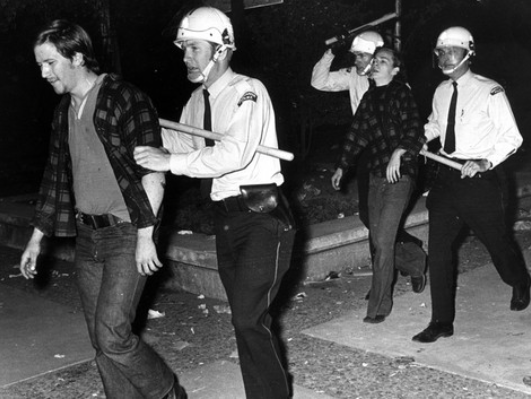
The picture up top shows police escorting two young men in matching "Mac" jackets beyond its frame. They say it was a riot -- the Rolling Stones Riot -- but they said the same of the police action that came to be known as the Gastown Riot ten months before it. But those jackets -- Mein Gott! They look like they were purchased that morning at Woodward's West Hastings.

Tuesday, June 6, 2023

What We Do Not Who We Are


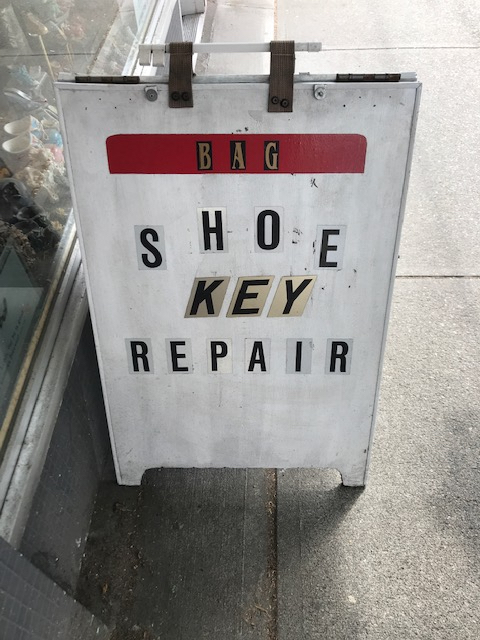
I always stop for signs like this. To take it in fully, but also to peek inside its shop to see if its interior is in any way related. Most times no, and this time, no exception.

Monday, June 5, 2023

Powers of Observation

I am now six stories into Mary Gatskill's nine story debut collection Bad Behaviour (1988), and the question of when these stories were written, and in which New York City, is on my mind.

Unlike most collections (debut or otherwise), none of the stories in Bad Behaviour were published prior to the original Poseidon Press edition, making it difficult to associate them in time and space.

Oddly enough, the story of Susan returning to New York (after arriving there some ten years before, as a U. of Michigan grad, only to leave NYC for Chicago four years later), could put "Connection" in Lou Reed's 1973 as much as it could put it in Lydia Lunch's 1983. (I keep forgetting that Gaitskill was born in 1954, not more recently.)

"Connection" is a fine third-person story that plays its trick with great effect: the seemingly normal-to-neutral visitor returns to a city for "a gorgeous wallow in sentimentality," where she thinks (secretly wishes?) she sees her frenemy Leisha as a "young bag lady," and from there we learn that if anyone is capable of going off the rails, it is Susan -- the only difference being that one is extroverted (Leisha), the other introverted (Susan). Each is as the other accuses them to be, which is to say selfish. From the start we learn that they were, for a time, dating the same person. (Are they, too, the same person?)

"Secretary" is the seventh story in Bad Behaviour, the one that was "made into" the 2002 film. I remember seeng the film when it came out and falling for Maggie Gyllenhaal. That's about all I remember. Maybe reading the story will return me to what I forget about the film? (A film I learn after peeking at its synopsis that is billed as a comedy?) Maybe reading the story will re-enforce what I already know about Mary Gaitskill's pathological honesty, her extraordinary powers of observation. 

Sunday, June 4, 2023

From Page 51 of Death in Venice


"Has it not been written that the sun beguiles our attention from things of the intellect to fix it on things of the senses?"

                                                       -- Thomas Mann, Death in Venice, 1912

Saturday, June 3, 2023

"I love beauty. Is not my fault."


More than anyone in Matt Tyrnauer's Valentino: the Last Emperor (2007), it is Karl Lagerfeld whom Valentino most wants to impress. Not surprising, since the original Thunderbird was probably closest to what Valentino was at that point: the world's last couturier.

The only thing worse than being last (as in remaining) is not having anyone around who can relate to what that means.

Lagerfeld was born a year after Valentino in 1933, and passed away in 2019. But Valentino continues to remain, now sixteen years into retirement after selling what remained of the company he co-founded with Giancarlo Giammetti in 1959.

This is a great documentary that rewards on a number of levels. We certainly learn about capital F Fashion: how it was when the designer had the power, how it became when money (what Giammetti refers to as "a language all its own") turned an industry (a maker of objects) into a business (a maker of profits).

Some favourite scenes come nearer to the end as Valentino's people are preparing his 45-year retrospective, with his greatest dresses lined up on racks. Valentino pulls one out and announces: "The embroidery! You could not make this dress today without selling an Italian bank!" Another is Valentino's reunion with his seamstresses past and present, who enter his exhibition en masse, where they are greeted by a humbled Valentino.

Friday, June 2, 2023

Show Me the Canada


ShowCanada wrapped up yesterday with a dinner atop Grouse Mountain. Surprisingly, not much grousing at the conference's Westin Bayshore home base these past couple days, with delegates from Canada's movie theatres in holiday moods, gobbling up food and drink, winning door prize trips to Hollywood and feeling the importance that comes with seeing previews of films by studio and distribution sponsors.

Corinne Lea from the Rio tried to speak up at the closing panel, asking one of the Cineplex Robs to stop muscling distributors into allowing Cineplex exclusive access to first-run films, both for greater profit, of course, but more insidiously, to starve out the independent theatres who have to wait sometimes as much as six months after a film's release to get it for a second-run screening -- only to be told by the Movie Theatre Association of Canada moderator, "Corinne, this is not the place for this discussion." But if not there, then where?

Cineplex accounts for over 70% of the Canadian exhibitor market, a statistic that goes up less through the growth of the company than as a result of a rapidly shrinking independent theatre culture. If this were the U.S., Cineplex would be considered a combine, taken to court and, in the spirit of capitalism, ordered to sell off enough assets (at market price, of course) to be competitive (as opposed to monopolistic). But this being Canada, where we are told by those defending combines that our market is too small and spread out to be served by a bunch of little guys, a different set of rules apply -- different in this case because they favour those convenient combines.

I imagine things will look a lot different by the next ShowCanada conference, with Cineplex already having branched out into distribution with Lions Gate Pictures, as discussed in a January 2023 article by the Globe & Mail's Barry Herz (after becoming a distributor, will Cineplex get into streaming, too?). Interestingly, Herz was given an award at the conference for his industry coverage. He must have known of his award because when I asked the conference contact person Carrie Wolfe (of MTAC) for a media pass for a story I was commissioned to write for The Tyee, I was told "we do not accredit press for the conference." Will Barry Herz be filing a story on ShowCanada, or does his award preclude him from doing so?

Thursday, June 1, 2023

"... how to reproduce the sensations of ordinary life while subverting the totalizing narrative that had stymied or withered our lives..."


Writers Who Love Too Much: New Narrative 1977-1997 (2017) is a book we knew about for so long that, by the time it was published, it was known only for that. It could have been called What Took You So Long, New Narrative?, where the distraction that has us wondering why no one is in a hurry to publish it is replaced by another distraction: the writer too busing loving too much to sign off on her proofs.

Edited by Dodie Bellamy & Kevin Killian, the book opens with an "Introduction" aware of 20th century American literary and perhaps interdisciplinary movements (Black Mountain?), with a focus on New York (School), San Francisco (Renaissance) and L=A=N=G=U=A=G=E as sites of critical interchange and innovation, with infusions of what we once and simply called "gay politics" and its post-Vietnam "Vietnam": HIV/AIDS.

The early angels of New Narrative are San Franciscans Robert Glück and Bruce Boone, with Glück's workshops a seminal force in the development of a local coterie. But it was Dodie and particularly Kevin who went to everything, the latter bringing glamour's bunting to whomever's room he stepped in or out of, to whomever's eyes he met and kissed.

Kevin carried an autograph book, but he was an autograph book. We leave impressions whether we are conscious of them or not, and Kevin is not so much "a part of all that I have met" (Tennyson), but a rememberer of that "all." There was a time when we were curious to know what Kevin thought of us. For about fifteen minutes it was something that all of us who were any of us simply had to know.