Tuesday, December 14, 2021

Blade (1998)


Blade (1998) began as a comic book before its adaptation to feature film. It succeeds because it does not depart from the stiffness of the comic book page, allowing that stiffness to deflect any questions we might have concerning, for example, Karen's ability to immediately put behind her the savage attack on her neck (and that of her medical colleague) to follow Blade around, participate in the burning of Pearl, etc. Not so much what people do after they are bitten by vampires, but what they do after they begin their lives as characters in a comic book.

But all vampires are not created equal. Some, like Dragonetti (above, left) are born that way, and some, like Frost (above, right) are "turned" (bitten). Frost wants to summon the Blood God to bestow him with super powers, level the playing field for all vampires (himself exalted), while Dragonetti and his multicultural star chamber like things the way they are.

DRAGONETTI (to Frost): I was born a vampire, as was every other member of this house. You Frost, you were merely turned.

A few scenes later, the one who was turned (Frost) exposes the OG vampire (Dragonetti) to a sunrise, where he suffers a gruesome death-by-CGI. 

When Blade came out, reviewers were quick to draw parallels between vampirism and capitalism as practiced by feudal organizations like the Cosa Nostra, as well as late-capitalism, in the form of extractive corporations like Halliburton. The link between drug addiction and endentured sex work was also alluded to, with terms like "turned".

Watching Blade today, I am reminded of a tension that is all but overcome now, and that is the notion of the "halfbreed", who, as Métis writer Maria Campbell reminds us in her 1973 novel of the same name, can be rejected by both "halves", not to mention the State. Nowadays the most talked about tension concerning those who began life in one category before transitioning to other options is the debate between those who feel a man who transitions to a woman (from he to she or they) is not truly a woman but a man-who-became-a-woman, or trans woman. That this debate is taking place amongst highly evolved feminists speaks to how that discourse, too, is in transition. 

I'm not sure how many Blade sequels followed, but I am curious to know if this identitarian question of "born" vs "turned" persisted. Seems the question of "ascribed" vs "achieved" status has been with us a while now; indeed, it is among the first things I learned in my Anthropology 300A (Kinship) class -- the difference between consanguinial (blood) and affinal (marriage) relations. For some, blood quantum is important when it comes to self-identitificaton, for others, self-identification requires not only blood relations but recognition from those whom you say you are from. Seems vampires, too, have a lot to learn about who they are, though I question the extent by which some, such as Democrat-turned-Republican Donald J. Trump, are willing to take it.

Monday, December 13, 2021

Holiday Viewing


Between Boxing Day and New Year's Day. The only time of the year (over two years, actually) when Time takes a vacation. The day's a blink -- and it's night again. At 4:30pm.

Mood is Time's stand-in, and it plays its own tricks, ultimately (a finite concept, ultimately) discarding Time altogether, or leaving us asking how it could've gone so fast, or so slow. Point is it behaves differently -- during this time.

Clock-time has a finite history and you can time yourself to see how long it takes you to hunt it down online, until you're satisfied you know enough about it, or are freaked out by it -- enough that you've had enough of Time.

Every year between Boxing Day and New Year's Day I program a film festival for one that goes by no name other than the films I assemble from my collection. On one of these days -- what I think of as the festival's "creation day" -- are the three films made by David Lean between 1962-1970. They are Lawrence of Arabia (1962), Dr Zhivago (1965) and Ryan's Daughter (1970). 

The people to which these film titles refer are a sado-masochistic homosexual British Army officer, a polyamorous Russian doctor-poet and a spoiled Irish teenager who seduces and marries her former school teacher, only to fall for the leader of her country's occupying forces. All three films largely take place during the First World War (1914-1918). Lawrence and Zhivago are epics, Ryan's a pastoral. 

Like acts in an opera, these films form a master narrative that I continue to struggle with. And I enjoy the struggle. Especially on those darkest days of the years.

Sunday, December 12, 2021

Pot Shots


I have yet to see the current Steven Shearer exhibition at the Polygon, though I did take a peek inside the gallery during the later stages of its installation and noted the works included and where they would be placed. From what I saw, this remains the art of an artist I have followed since the mid-1990s, only more so. Anyone interested in painting should see this show, for the paintings alone. A curious and unsettling mix of gothic, metallic and effete male forms "clothed" in the historic palette and brushwork of the late-19th century Symbolists. 

In addition to the Globe's grudgingly positive review, the exhibition has garnered at least two more local reviews, one by Yani Kong at Galleries West, the other by Dorothy Woodend at The Tyee. These reviews, too, are grudgingly positive, with Kong concluding hers by asking if Shearer's pantings, sculptures and collages are relevant, particularly when compared to "some of the world's most relevant artists" included in the Polygon's previous Interior Infinite show, a comparison that, though intended as a compliment, does a disservice to its curator Justin Ramsay by limiting his accomplishment ("an astute reflection on race, gender and identity") to his selection and inclusion of artists without saying anything of the work that was, to put it crudely, there to represent them, to say nothing of how their work was configured and contextualized.

As for Woodend, she opens her review with a sentence ("Sometimes you can look at a work of art and appreciate the skill, concept and execution, and still not like it very much") that speaks more to personal taste than to the work at hand, a decision that refocuses the review on the critic as a computational apparatus enslaved by today's most common (relevant?) criterion of judgement: the binary like|dislike. While I too find myself repulsed by what Woodend refers to as "dude culture," I remain interested in my repulsions. Not at the dismissive level of like|dislike, but by what should follow from it. I had a similar experience recently while watching the Lord of the Rings Trilogy, simply to track variance amongst that automatonic, subservient, soldiering mob known as the Orks, of which there was little to none. For our purposes, Orks exist entirely to be feared and hated. But the mostly male figures in Shearer's paintings are more complex than that, and they bear a more considered look.

Take, for example, the subject of Shearer's Potter (2021): a willowy, Eno-esque urban figure in last night's party pants, awash in concert lighting and throwing a pot before a backdrop that includes an inventory of jarred organs. This is not your stereotypical Gulf Island potter, nor is it your androgynous 1970s prog rocker, but a confusion of signifiers in support of -- and indeed in resistance to -- some very sophisticated painting techniques. To reduce this complicated subject to a participant in "dude culture" is an abdication of the critic's role to broaden our experience, not reduce it. As for those jarred organs, they function at the level of a test: if you believe them to be souvenirs of a serial killer, then you will not "like" this work; but if you see the potter as a biologist whose hobbies include pottery, you might want to know more than what you're getting from a connoisseurial review.   

As a undergrad in the early 1980s, I remember one of my profs telling us that poststructuralism has contributed to a crisis in Marxist discourse, with many of its scholars returning not to Marx's writings but to that bible of capitalism that Marx was so critical of -- Adam Smith's Wealth of Nations (1776) -- for a closer (Marxist) reading. Around that time I remember another prof telling us that first- and second-wave feminists put off by the ascendancy of Naomi Wolf's superficial The Beauty Myth (1991) have begun devising courses on "masculinity" in an effort to better understand patriarchy and, as bell hooks insists, how it affects not just women but men. Shifts like these seem unthinkable in our quick-to-signify moment, yet they are needed if the critical conversation on art is to transcend, let alone survive, our moment. And with any luck, bring Art with it. 

Saturday, December 11, 2021

Desert Sweater


In the fall of 1987 I received a bad diagnosis from my doctor and moved into my parents' house for a couple months to recover from surgeries and chemotherapy. During that time my mother, who by then had resumed her knitting practice, asked if I would like a sweater, and I said Yes, can I design the back of it? and she said, Yes, of course!

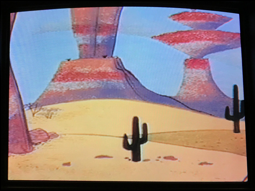
After selecting the style (zip-up front, no collar), she gave me a sheet of gridded paper on which to plot my design. What I came up with was pictorial and based on drives I had taken through the deserts of the southwestern U.S., though my mother cautioned me it could end up looking more like a Chuck Jones Coyote/Roadrunner landscape than anything I might recall from my travels.

She was right, of course. Not that I loved it any less.

Truth be told, I didn't get a lot of wear out of my "desert sweater", but I liked having it around, taking it out on cold days to wear over my pyjamas while I watched TV or read. More a security blanket with arms than anything I would wear in public. But as the years wore on, I came to associate the sweater with my illness, or at least that part of my illness I wanted to be clear of. Chemotherapy (vinblastin, cisplatin) was brutal, the hardest thing I have ever endured, and I hope I never again have to go through it.

Last year, in an effort to add space to my life, I went through my clothes and ended up keeping only one-tenth of them. Some were made into rags, though most were given to the Salvation Army. There were some nice articles, a good portion of which I shared with friends and their children, and what wasn't wanted I took to Natalie at Woo, who gave me cash and credit. Among these clothes was the desert sweater.

It was while going through my clothes with Natalie that I noticed one of the two front pockets on the sweater was moth-eaten. I attempted to withdraw it, but she said no, she could fix it, and I appreciated that.

A couple weeks ago I stopped into Woo and Natalie told me she had my sweater in her window and that it caused a brief sensation. A number of people had asked to try it on, with one of them coming back to buy it, and a few more coming by after that to ask if it was still for sale. I asked if she had a picture of it in her window, and she said she did and would send it to me. That night I phoned my mother to tell her, and she said she remembered knitting the sweater, but not what it looked like. I emailed her the picture and it all came flooding back. Happily, tearfully -- because there was a part of her that thought I wouldn't make it.

Friday, December 10, 2021

MCC Thrift Shop


Back in the late-1990s, after I passed on the keys to the Malcolm Lowry Room and my time was truly my own, I found myself in the habit of getting up each morning and, as quick as I could, getting in my car and driving somewhere. I had a number of these somewheres in my life, the most visited being a cafe just east of Commercial Drive, on the south side of Charles Street, called Harry's. It was only after shooting three games of pool while kibitzing with Harry that I felt focused enough to return home and do what I do for a living, and that is write.

Somehow, for some reason or reasons, I find myself back in this habit. And so it was that I set out yesterday for the MCC Thrift Shop on Fraser Street, in search of what I don't know. The whats this time turned out to be two cotton place mats in a shade of green (sage?) that have, through no conscious effort, become an accent colour in my living space, as well as a beautifully constructed wall hanging made of twigs from a bush or tree, likely from the other side of the Pacific. Supplementing that, the usual array of books, CDs and DVDs, but this time just books, which include:

Other Fires (1986), because I mentioned it in a recent piece I wrote for Ormsby Review of another anthology, called emerge 21,

and Marie-Claire Blais's St. Lawrence Blues (1973), because she passed away last week and all I ever knew of her, besides reading with her at a festival once, is La belle bête (1959).

Thursday, December 9, 2021

Public Art


Yesterday the Vancouver Sun published a story on the barge that remains grounded at Sunset Beach. The story, inspired by a social media meme, concerns the barge's status as a work of public art. But rather than provide a quote from the City of Vancouver's many specialists on public art, the Sun's Kevin Griffiths instead relates the opinions of a former private art gallerist and founder/president/board member/curator of the Vancouver Biennale who, through the assistance of former city councillor and initiative arm-twister Jim Green, uses public space as a showroom for his public art commissions/selections, sometimes towards their sale, from which this founder/president/board member/curator's Biennale benefits. Does the City, as the Biennale's open-air venue-provider, receive a portion of that financial benefit? Has the Sun ever thought to ask him that? Or the City? Just what is the leasing agreement between the City and the Vancouver Biennale?

The founder/president/board member/curator of the Vancouver Biennale doesn't believe the barge is, in itself, a work of public art, though he doesn't really tell us why, or what public art is. He does, however, believe that if the barge is painted, it might qualify as such -- like the painted cement silos on Granville Island, a paint job he commissioned for a previous (2014) Biennale on a structure that one Vancouver photographer thought resonant enough as is, but the Biennale founder/president/board member/curator saw as a blank slate, a turrim nullius, something to colour, turn into dolls, infantilize, anything but celebrate what those gorgeous silos were designed for, as truth-to-materials examples of industrial design. Don't mean to get all Corbo here, only to remind those old enough of a time when newspapers had visual art critics, first, all-purpose journalists, second.

Wednesday, December 8, 2021

Monodromos aka One-Way Street (1973)


Every few years Marian Engel's fifth novel Bear (1976) experiences a revival, for different reasons every time. The most recent revival noted the author's concern over the appropriation of Indigenous stories.

Something that is lacking in these Bear revivals is attention to Engel's other books, most notably her novel Monodromos (Anansi, 1973), renamed One-Way Street when it was re-published by Paper Jacks, an imprint of the equally-defunct General Publishing.

In Engel's Goodreads bio, all but Monodromos bears mention. I wonder why that is, for it is, to mind, her most resonant book. As far as Mediterranean novels go (novels that are set there), it ranks with Fowles's The Magus (1965) and Berger's G (1972) for imagination, insight and some very fine writing.

Marian Engel died of cancer in 1985. She was 51.

Monodromos is not included in Engel's Maclean's obituary, though it does mention a trip she and her ex-husband Howard Engel took to Cyprus in the early-1960s, which likely inspired the novel.

Here is an early paragraph from Monodromos

"The island has passed from hand to hand with history. Only Napoleon and Kubla Khan seem to have neglected it. It has been an adjunct to every other empire; it's out of its British phase now, waiting for history to clear and clot again, to see what it will become. It has a wan look in the winter sun: this desirable property to let. I hope the islanders are shrewd about the rent." (3)