Tuesday, November 30, 2021

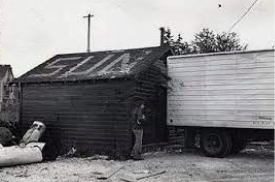
Skookum Wawa (1975)

For travellers who find reading and writing an essential service, I’m sure there is at least one anthology in your past whose gates you opened and explored its pages, finding yourself at home in some of its writings, losing yourself in others. Sometimes indifferent to voices that sounded like yours, other times attracted to those that did not. Sometimes, too, a neighbourhood of writings -- if not the entire town  -- whose collective resonance rang greater than the sum of its parts. To the point where you might have wondered who it was that brought together and arranged these writings, and thus returned to its gates, to see who was responsible.

Poet-editor Gary Geddes's Skookum Wawa: Writings of the Canadian Northwest is a textbook that came out the year I entered high school, and by all accounts hung around for years after. (The words "skookum" and "wawa" belong to a Northwest pidgin trade language known as Chinook Jargon, and translate into English as "good" and "talk", respectively.) Rather than divide itself by genre, Geddes intermingles lineated poetry with paragraphic prose, non-fictive exposition and photography.

I thought little of Geddes's anthology when it was assigned to us in Grade Eight -- more an imposition than anything else -- but when I looked through it many years later (while waiting to do a library reading in Smithers), I appreciated the arrangement of its writings, despite the fact that all of it is by white settlers. Would renaming the anthology change that? No. Nor would adding to it Indigenous and diasporic writing. In this case, best to start again -- beginning with an Indigenous editor and the writings of Indigenous authors. As for the inclusion of writing by white settlers, I can't think of an Indigenous editor who has done such thing. Is it too early to do so? Never too late?

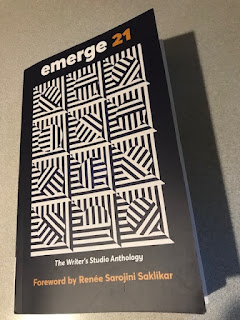
The opening (italicized) paragraph of this post is the opening I wrote for my review of SFU's Writer's Studio emerge 21 anthology, as commissioned by the Ormsby Review. (I abandoned my previous Ormsby review of Gregory Betts's Finding Nothing: the Vangardes, 1959-1975 once I realized I was writing -- and could only write -- a book-length response.) Although largely impressed with the quality of writing in emerge 21, I was critical of the editors' decision to organize it by genre, and it is in my review that I mention the example of Skookum Wawa, how it blended genres, as opposed to keeping them penned in, imprisoned, in chapters.


Monday, November 29, 2021

A Hedge


The west side of Clark Drive looking north, before the dog leg behind me turns it into Knight Street. The laurel hedge juts from a yard and has been shaped by the rigs that pass under it. This is a sight to see, because the difference between the top of these rigs and the bottom of the farthest expression of that laurel is an inch, give or take. The width of the hedge couldn't be more than three feet. The light standard is a sundial: 11:30 a.m. (November 17).

Sunday, November 28, 2021

What's Old on Kingsway


Now that the rains have passed from sweet music to claw scratchings, I do my best to get outside during its silences.

Yesterday, while walking back from Famous Foods, I noticed an excavator's bucket rise up from the middle of the 1200 block Kingsway, north-side. Could it be that, after all these years of boarded windows and metal fencing, these low-rise buildings are finally coming down? Sure enough. The building that once housed the Kitsch's Brew coffee house is now gone, as is the one just east of it, where a meth lab technician was blown out of its upstairs window and found sprawled on the sidewalk, laughing.

As for the building where Kitsch's Brew moved to -- that stimulant complex known as the Cedar Cottage Pub at the southeast corner of Kingsway and Clark -- it is currently in the asbestos-removal stage, after everything of value was salvaged by contractors and the copper wire miners who roam our streets and alleys.

An advantage to tearing down wooden, stucco-clad buildings during rainstorms is the absence of dust control devices, like those fountainesque hoses that have become a fixture at demolition sites. But these buildings were likely coming down on these days anyway, so I suppose it's more a cost-saving coincidence than anything else.

Saturday, November 27, 2021

Witnesses Needed


The rains of two weeks ago were so severe they wiped our utility poles clean of notices and this one I found blowing across Clark Drive. Every time I leaned down to photograph it, the wind pushed it a few feet further, where it momentarily recomposed itself before resuming its journey. This is the last picture I took of it before a minivan screeched to a stop behind me. The driver, incredulous, asked I was trying to get myself killed, and I said I was trying to help a fallen cyclist.

Friday, November 26, 2021

Dangerous Liaisons (1988)


John Malkovich has a fascinating screen presence that has as much to do with the roles he plays as the looks and voice God gave him. Like Marlon Brando, both possess oddly contrasting features -- strong brows and dead eyes, winning chins and lisps. It is qualities like these that allow their characters' their powers of ambiguity.

In Stephen Frear's Dangerous Liaisons (1988), Malkovich plays an 18th century aristocrat and sexual predator, and that should be enough (Malkovich recently played a Harvey Weinstein-like character in David Mamet's Bitter Wheat, 2019), but there's more. Check out Roger Ebert's review. Ebert writes like he's read the DL source book and seen its stage adaptation. For more on Malkovich, here's a recent lockdown-era profile in The Guardian. 

After watching DL the other night I awoke the next morning from the dream it inspired. For there I was, my ten-year-old self drawn once again to the energy of the paper shack, those 6'x8' pitch-roofed British Racing Green painted huts on skids that the Vancouver Sun dumped in back alleys, where paperboys gathered after school to collect and fold their papers. The shack I remember best was in the dusty alley behind the Big Scoop at West 41st and Balsam. Among the older paperboys was a mincing, drippy bully who dominated the scene while at the same time appeared indifferent to it. I wonder who, what and where he is today?

Thursday, November 25, 2021

Be True to Your Stool


It's the rule, there's a stool, there's a stool

Barrow is the name of the small town in André Alexis's Pastoral (see yesterday's post), Blaine in Christopher Guest's Waiting for Guffman (1996) -- the story of a former off-off-off-Broadway hopeful (Corky St. Clair) who helps a small Missouri town produce an epic musical for its sesquicentennial. Among the highlights in Blaine's history is furniture production; stools in particular after someone gave President McKinley one while he was passing through town, and he liked it. 

Wednesday, November 24, 2021

Pastoral (2014)


Toronto-based writer André Alexis is an ongoing presence in Canadian writing, someone whose books (usually Childhood, 1998 and Fifteen Dogs, 2015) appear on the shelves of homes I have visited, yet a writer I have never read in book form until recently, when I saw a copy of his 2014 Pastoral in a box at AA Furniture & Appliances and thought, Okay, this time. 

As it turns out, Pastoral is the first of Alexis's Quincunx series, a configuration of five books, the most recent, Ring, was released in September, 2021. I am now 50 pages into Pastoral, and I have to admit, the going was slow at first, for no other reason than my aversion to young Catholic priests coming to town. But as there was something not quite inhuman about this servant of God (he was hoping for something larger than the town of Barrow), and because his butler brought to mind Georgia McKinley's Leroy from her short story "The Crime" (1959), I stuck with it.

The first turn comes in the second chapter ("May") with the sudden death of what had appeared to the priest as a potentially problematic parishioner, the unpopular Tomasine Humble, whose passing sets off a chain of events that gives the town much to talk about, wonder about, and this talk and wonder has consequences, too.

Here's the paragraph that turned me around, that reminded me I was reading a pastoral:

"After Tomasine's death, the ground in the graveyard was more dense than it had been, with another body -- the cold, curdled earth -- to digest. The currents of air that visited Barrow had one less person to circle or caress. And the wind as it blew through town made a sound ever so slightly altered. The ants had one less hazard, the birds one less predator, the worms one more meal. The foxes and coyotes could now go about their business without Tomasine Humble in mind. The fish -- carp, bass, minnows and catfish, mostly -- would have been very unlikely to feel anything at all, save that, in spring and summer, it had been Tomasine's secret pleasure to put her feet in the Thames from time to time, to feel the cold water run gently over them. No more of that hazard for the fish." (38)